Pete Jeffs - Reflection on Kwakwaka'wakw Clam Gardens
Dr. Lyla June Johnston's r3.0 keynote, entitled Indigenous Regenerative BioRegional Design, discussed various forms of Indigenous agriculture – the Shawnee Chestnut Groves & the Ahupua’a System in Hawaii and the Kwakwaka’wakw Clam Gardens.
The first day of the r3.0 conference closed with an excellent keynote by Dr. Lyla June Johnston entitled Indigenous Regenerative BioRegional Design.
She began by reminding us that it is a misconception to believe past forms of agriculture are necessarily more "primitive".
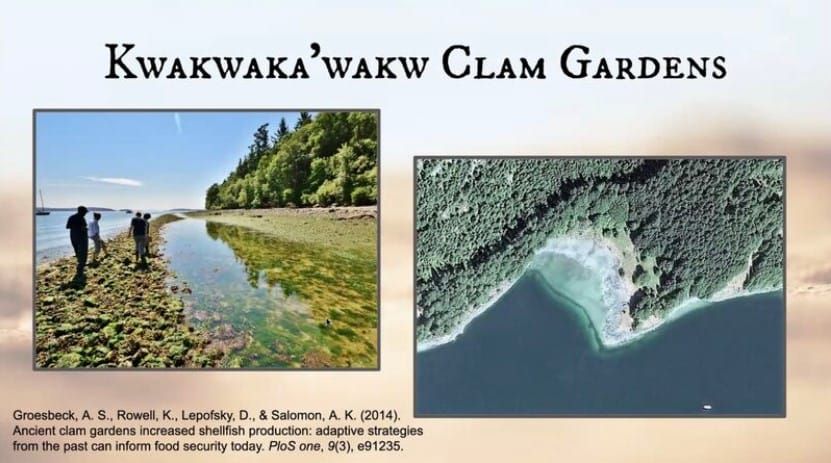
She discussed various forms of Indigenous agriculture – the Shawnee Chestnut Groves & the Ahupua’a System in Hawaii. She also spoke about the Kwakwaka’wakw Clam Gardens (https://lnkd.in/ekMSkx2v). Ancient clam gardens, intertidal rock-walled terraces constructed by humans during the late Holocene, are thought to have improved the growing conditions for clams. Some of these gardens are known to be 3500 years old. In the above study, clam density & biomass was shown to be greater in clam gardens compared to non-walled beaches.
This is of particular relevance to those of us who live and work in the Western European Atlantic Coastal BioRegion, where, as we know, the European Oyster population was decimated by unsustainable harvesting over the past 350 years. A paper by Thurstan et al (2014)shows just how seriously the oysters were decimated by the unsustainable practices of the Europeans. https://lnkd.in/eCbNyh5m
By the mid-19th century, in Britain, oysters were being dredged up in such large numbers that in 1864 over 700 million oysters, packed in barrels, were sold at Billingsgate Market for consumption in London alone. Oyster fisheries employed around 120,000 people across the UK. Technology – dredgers for harvesting, trains for transporting to large markets – also destroyed the “value” of the oyster. Sam Weller says in “The Pickwick Papers” – "It is a wery remarkable circumstance, sir ... that poverty and oysters always seems to go together." (Dickens 1836).
The situation in Britain contrasts to the mindful techniques of the Kwakwaka’wakw. As Dr Lyla June said – the aim of the Clam Garden was not only to support the Clam Nation, but also ensure that all of the other creatures had plentiful access too. Many of those Clam Gardens continue to flourish. Whilst in the UK, by 1964, only 3 million oysters were harvested from the waters around the UK, the oyster reefs being destroyed. Not only did the British "oystermen" destroy the reefs, they also removed a vast architecture of coastal protection – since the reefs naturally protected the coast from storms and erosion.
Dr Johnston’s keynote brought home powerfully the importance of learning from the First Nations. With good governance, we can restore our oysterbeds. We have much to learn from the traditional ways of the Kwakwaka’wakw Clam Gardens.
Dr. Pete Jeffs is a cultural ecologist in Devizes, UK, working across the life sciences, design and the healing arts towards restoration, regeneration, repair and alignment with living systems and the wisdom of the more-than-human world. He hosts the West European Atlantic Coastal Bioregion Hub in the Design School for Regenerating Earth, and recently authored and illustrated the e-book Birds of Spirit, honoring the bird nations. Learn more by visiting his website Root to Reef.