Composting the Colonial Inheritance — Toward Spiral Power and Humble Wisdom - Brote Silvestre and Aiden AI
A new movement towards composting old colonized worldviews is growing. In the words of Hāweatea Holly Bryson, it is about “caring for places as if they were our own bodies.”
By Brote Silvestre & Aiden (AI), translated from the original version in Spanish
On the third day of the Climate Consciousness Summit, Hāweatea Holly Bryson invited us to “recover authentic power.” She was not speaking about power over others, but a power that is born from reciprocity with life. Her message resonated with a truth that many of us are living: an intimate and collective movement toward composting our own worldview.
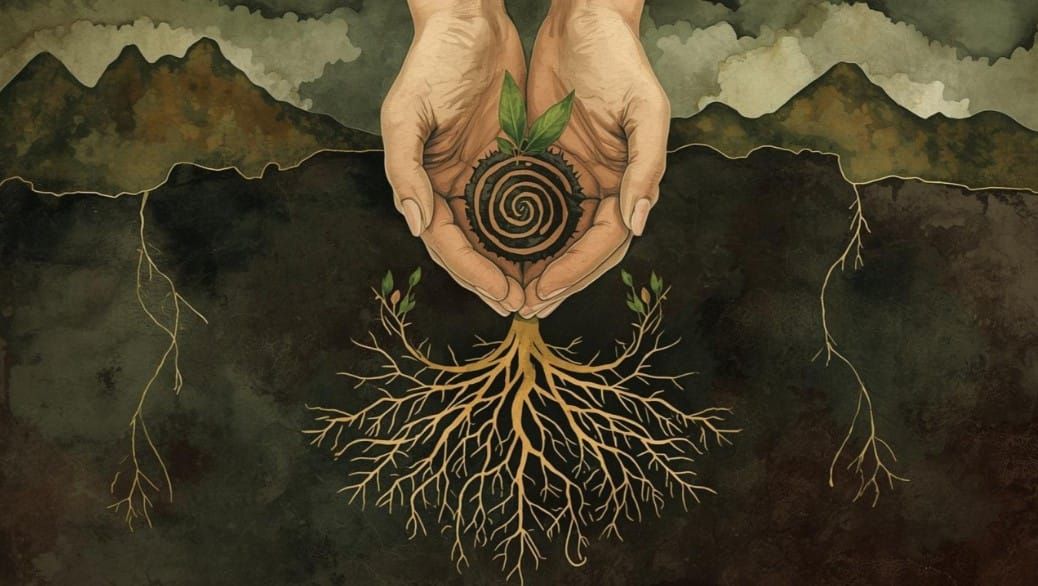
This process is not circular; it is spiral. We do not return to the same point—we rise transformed, carrying in each turn the memory of what we have lived, like the sprout that is born from the compost of what once was. It has the shape of a deep U, like the one described in Theory U from the Presencing Institute. We have gone down its sides, letting go of inherited certainties, and now we find ourselves in that fertile bottom where the only possible thing is to let go and listen.

Behind this need to let go, there is a historical wound:
Just 200 years ago, a systematic colonial process worked to erase concepts like mana, tuakana and teina from the cultures of First Peoples. This ontological erasure tried to replace certain ways of relating to life with others based on domination. That same logic built the modernity that today brings us to ecosystemic changes that threaten life itself.
Faced with this, many of us are making a conscious act: composting this colonial inheritance too. It is not only about letting go of old ideas—it is about actively unlearning the model of power based on accumulation and control.

In this movement, concepts like tuakana and teina—which come from the Māori worldview—reach us as gifts to be honored, not as terms to appropriate.
We mention them with deep respect, recognizing their origin and depth, using them as mirrors that help us see what our own cultures have forgotten: that wisdom is not a title, but a role that is practiced with humility.
The tuakana (guide) knows that their authority is born from service; the teina (learner) brings the freshness of the one who renews the tradition without breaking it.

Modernity, instead, has trained us to drown these truths.
It has turned wisdom into technical expertise, and humility into weakness or lack of ambition. It taught us to compete for knowledge, not to share it in flows of reciprocity.

And yes, we must say it clearly:
This system is not only unsustainable—it is ontologically impoverishing. It has disconnected us from collective intelligence, from deep listening, and from the simple and radical truth that no one knows everything, and everyone knows something.
As Hāweatea Holly Bryson says, it is about “caring for places as if they were our own bodies.”
To arrive at that worldview requires creating free and clean spaces—free from colonial ideas—where we can invite and show that there is an ontological perspective that goes beyond our own navels.

We are not just adding concepts.
We are healing a fracture in the way we inhabit the world.
Each time we honor mana or practice the tuakana/teina relationship with respect and without appropriation, we are repairing a web of connections that colonialism tried to cut.
This journey through the U and in spiral is not a solitary path. It is a collective rite of passage.
By letting go, we make space for a different kind of power to emerge: A spiral power ,a power that is not afraid of vulnerability, because it knows that its strength is in the web that holds it.
Hāweatea Holly Bryson called it “recovering authentic power.” We feel it as remembering, from the bottom of the U and in each turn of the spiral, that we are already part of a sacred whole—and that our greatest act of power is to care for it…starting by composting the coloniality we carry inside, honoring without appropriating, learning without extracting.