Rupture and Renewal: A word-weaving from the World Adaptation Forum
Could collapse be liberating? Could the warm social bonds of Mutual Aid that have always been our deepest human nature help us dismantle the 'MegaMachine' and allow something more flexible and robust to emerge in its place, asks Pablo Servigne at the World Adaptation Forum in Budapest, Hungary

By Megan Lindow
Listen to the article here:
"We are gathering at a strange moment in history – a moment when many things still look normal, still function, still shine, still move. And yet, beneath the surface, more and more people can feel the world we have built is becoming less stable, less predictable, less trustworthy. We still live inside continuity, but we are already thinking inside rupture." – Balázs Stumpf-Biró, co-convenor with Zsolt Szalóczy of the World Adaptation Forum.
These words opened the World Adaptation Forum last week April 23-24 in Budapest, Hungary, a gathering of historians, climate scientists, economists, system thinkers, resilience researchers, risk experts, strategists, and authors whose work, Balázs noted, helps us see more clearly what sort of age we are entering now.
So many human and planetary systems are unravelling at once – with precipitous crises of warfare and the 'Fuse of Hormuz' (see our StoryWeaving Salon with human ecologist David Korowicz, who ran a Day Zero adaptation scenario before the meeting, below) compounding dangerous systemic risks like runaway climate change and global food and water shortages. The Forum's two-day program wove both troubled and uplifting poetry from themes of climate disruption and planetary overshoot, the collapse of economic myths – social fracture, food system failure, systemic risk, leadership, community, mutual aid, grief, curiosity, imagination, resilience and resistance.
As the human ecologist William Rees remarked in a recorded opening address, the Forum brought together "some of the most fearlessly engaging thinkers on Earth to tackle the mind-numbingly complex, potentially fatal metacrisis generated by modern techno-industrial society." These included the prominent collapsology thinker and author Pablo Servigne, imaginative futurist and founder of Collapse Forward Maya Frost, systemic risk expert Sarah Hendel-Blackford, food systems disaster researcher Juan García Martínez, among others (see the speaker's program here).
Journeying with the stories of complexity and fracture, to resilience and renewal, I was reminded of Otto Scharmer's Theory U of transformation. With open mind, open heart, open will, speakers and participants were urged to bring their diverse perspectives to a deep inquiry into what is really unfolding on a planetary scale. Only through our willingness to perceive reality and meet its depths with courage and clarity – might we open our imagination to the emergent possibilities of the present and future.
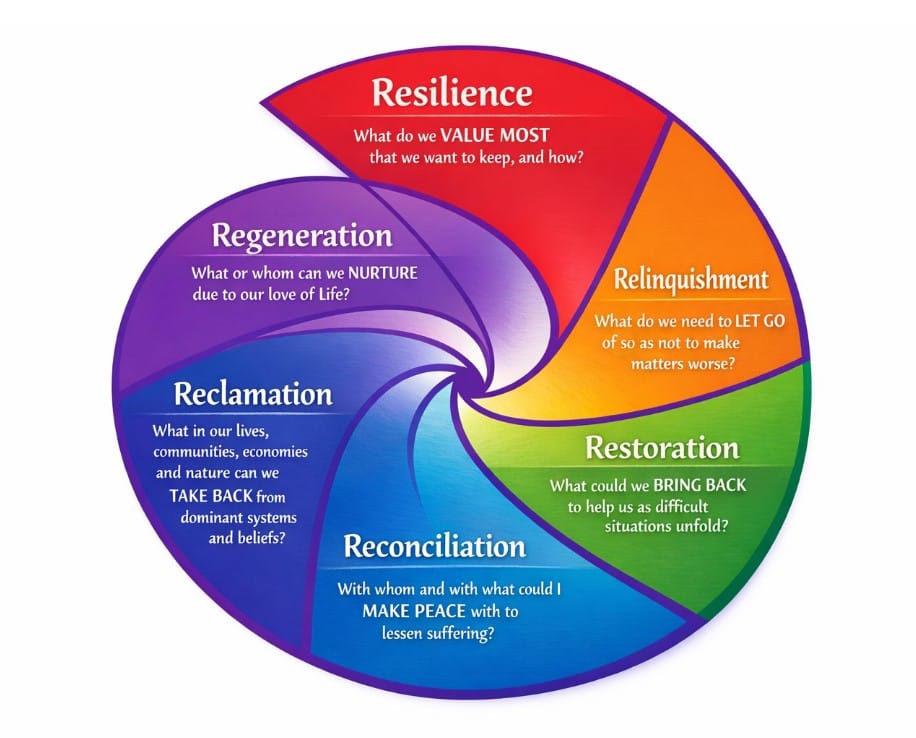
As we face the Great Unravelling, as Joanna Macy termed it, we are at the same time called to lean into the Great Turning towards beauty and renewal that is also underway – an idea that also resonates deeply with Jem Bendell's Deep Adaptation Framework (newly updated!) as his work was a key inspiration behind this meeting series, now in its third year. As you will read below, the perspectives and stories shared by the speakers (of which we could have included many more!) resonate profoundly with the Deep Adaptation questions – from resilience to regeneration – posed by Jem:
William Rees offered an evolutionary perspective on the human predicament, reflected in history as every known civilization of the last 6,000 years has exceeded its biophysical limits and collapsed. Humans evolved biologically as caring and cooperative mammals, with warm social bonds. With the rise of complex civilizations, however, our cultural and technological innovations set us on a destructive path, Rees said. (Interestingly, I note Riane Eisler's argument in her work The Chalice and the Blade that only with the rise of trauma-induced patriarchal dominance cultures, and not 'civilization' itself per se, did humanity's destructive trajectory arise – a future topic perhaps to delve into!)
Rees said: "If we compress humanity's 350,000-year history into a single day, then 6,000 years of so-called civilization takes up 2%, just the last 25 minutes before midnight. The technological avalanche, the population quadrupling, and the ecological crisis brought on in the last 100 years occupies just the last 25 seconds. But people haven't much changed. Cultural evolution has therefore so outpaced biological evolution that our brains have been rendered functionally obsolete."
Our brains evolved to live and tell stories. We are wired to absorb the socially constructed myths, dogmas and narratives of our communities and cultures – and then live them out as if they were real. Wearing these "mythic blinders" – what the writer George Tsakraklides later referred to as our cognitive biases of human supremacy and technological optimism – as our globalized civilization and culture continue to drive and reinforce behaviors of extraction and consumption, it appears we almost cannot help but destroy the biophysical basis of our own existence on a finite Earth.
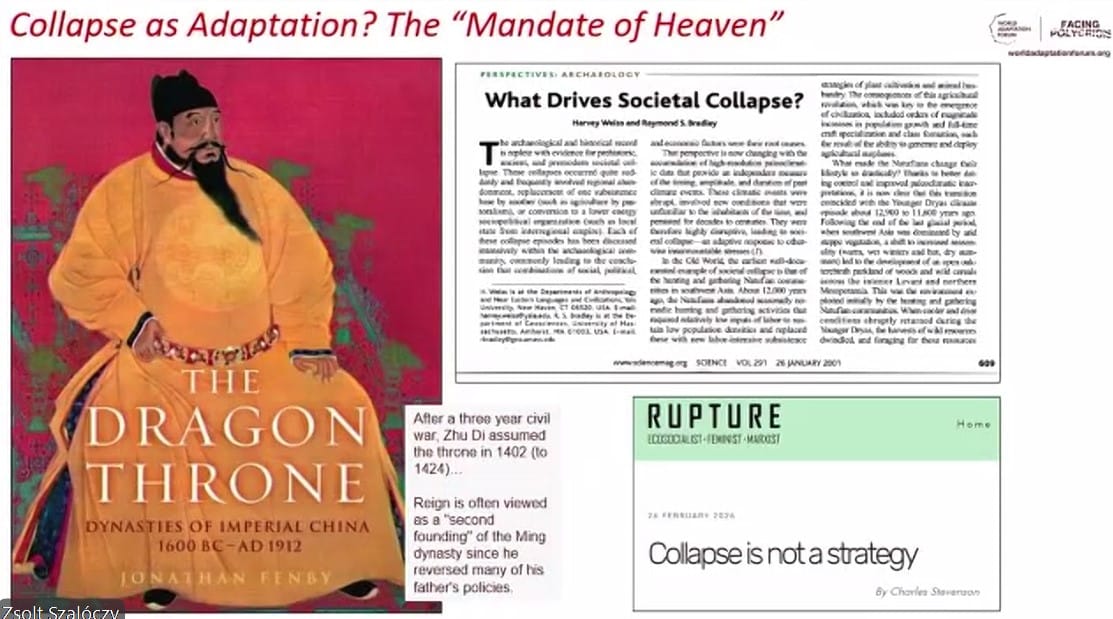
Tracing China's imperial past through the "natural archives" of volcano ash held in ice cores
As we heard from World Meteorological Organization climate and energy scientist Roberta Boscolo, long term climate instability is already locked in, even under a best case scenario. Climate disruptions happened in the past too, and studying these is helpful to shed light on how the stresses of climate, extreme weather, conflict and social upheaval played out historically.
Francis Ludlow, an Associate Professor of Medieval Environmental History at Trinity College Dublin, shared fascinating insights about the likely role of climate disasters in destabilizing ancient imperial Chinese dynasties.
As he and other speakers stressed, it is important to dispel popular myths about what collapse actually means. Historically, collapse has not meant a sudden and total breakdown of society, with Hollywood-style chaos and looting in the streets. Collapse has often brought painful consequences to local populations, of course; yet the built environments, cultural identities and traditions of collapsed societies often continued under the new nations, tribes or empires that rose next, he said.
Francis studied "natural archives" – the records of atmospheric pollution held in ice cores drilled from the two-mile-deep ice sheets of Greenland and Antarctica – to understand how volcanic eruptions, occurring much more frequently in the past than in our current era, may have influenced the rise and fall of Chinese dynasties over a 2,000 year period.
Chinese history offers a great laboratory to study this question, he said, as 68 precise dates of dynastic collapse can be counted over this period. The dynastic history is incredibly well documented, he said, partly because successors believed they had a duty to detail the history of the dynasty they had legitimately ousted, just as the next dynasty would faithfully detail their history. "Because of this, we can actually chart the pressures faced by each dynasty in great detail, including the levels of internal and external warfare over two thousand years," Francis said.
Over the same 2,000 year period, 156 volcanic eruptions occurred that were theoretically large enough to impact the climate and affect food production. Yet as Francis noted, the large eruptions known to have impacted food availability did not always correlate with the times of warfare and collapse. In cases of widespread pre-existing warfare, even a smaller eruption could trigger collapse; while in periods of greater political stability and resilience, it would take a much larger eruption to destabilize society. Societal, economic and cultural resilience could be strengthened, for example, with lower levels of poverty and inequality, or if food relief was made available during times of hardship. Interestingly, Francis described a famine relief manual from 1406 AD detailing edible wild foods locally available!
"I think it's probably fair to read this as a cautionary tale of how societies are, or can make themselves, particularly vulnerable if they're experiencing multiple stressors, and certainly polycrises, where the impacts can then compound in unexpected ways," Francis said.
In some cases, he added, collapse itself can be an adaptation to environmental stress and instability. While Chinese emperors had to take responsibility for conditions of famine and other disasters, Francis observed, contemporary leaders deflect criticism and blame for their poor decisions, policies and lack of preparation by referring to fires, floods and damaging storms as "natural disasters."
"There really is no such thing as a natural disaster," Francis said. "Only natural hazards that become disasters because of human choices."
Generations of Global Warming
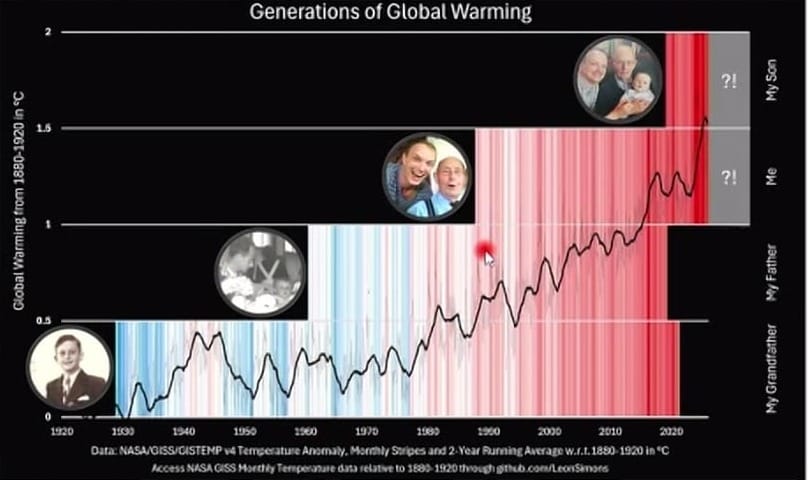
As Roberta's presentation made clear, climate change is advancing and accelerating, with many of the worst case projections coming true, ranging from ocean heat and acidification to melting glaciers and sea ice – each with its own cascading and accelerating feedbacks.
Leon Simons, a climate systems analyst and executive director of the Club of Rome, Netherlands brought the realities of contemporary global warming close to home with photos of four generations of his own family positioned on a graph showing global temperature rises over the last century. Those born into the current generation, including his own son, will face a hotter climate than has existed for millions of years, he said.
The Limits to Growth report written by Donella Meadows and published by the Club of Rome in 1972 already identified humanity's dangerous trajectory of planetary overshoot. The report's key message was that endless resource extraction and economic growth is not sustainable on a finite planet. As sustainability researcher, post-growth economist and Club of Rome member Gaya Herrington put it – humanity must choose its own limits, or else the Earth will impose limits when we break her geophysical boundaries.
Gaya revisited the report's scenarios (pdf) and found that, notwithstanding the existence of much larger oil reserves than were known in the 1970s, humanity has more or less followed the "Business as Usual" trajectory, in which growth levels out as ecological limits are breached – and then, around the time of the present day, there begins a steep and rapid decline that the authors termed "collapse."
As the leadership and resilience expert Elizabeth Tengbergen later observed, "We are living inside of those projections now."
Yet while the Earth's limits are biophysical, the human economy is a social construct, and therefore can be changed. Initially supportive of the Limits to Growth report, once the elites grasped its implications, they buried it, Gaya said, because it pointed to the need for a great redistribution of wealth.
Not all the Limits to Growth scenarios ended with collapse. In order to avoid it, she said, we must deliberately choose to redirect our focus from growth to reducing our ecological footprint while safeguarding livelihoods and providing education, health and wellbeing for all.
From a wellbeing economy to a post-growth or degrowth economy to an indigenous economy to a regenerative economy to Kate Raworth's Doughnut Economics, we already have numerous design frameworks to draw from. "They all agree on the same thing, in essence," Gaya said. "You can't have perpetual growth. It's a foolish pursuit. It has to be replaced by some notion of human and ecological wellbeing, an economy that's in service to life, not the other way around."
When everyone's basic needs are met, Gaya said, we become free to embrace our true human nature as cooperative beings who evolved within egalitarian structures that enabled us to survive the ice ages of the paleolithic. "We have to move to a different story that I think is best preserved in indigenous communities, that we are nature: the story of interdependence. And once our basic needs are securely met, we are much more social and curious and altruistic and playful than this Homo Economicus could ever be," she said.
Bioregionalism is one story that encapsulates a future of attunement with life and place-based, cooperative community building. She played us this inspiring video announcing the upcoming Turtle Island Bioregional Congress, happening in Cascadia September 2026.
From cognitive bias to 'thoughtful inaction'
Foolish as the pursuit of growth may be, however, that does not necessarily mean we will stop. The biologist, systems thinker and author George Tsakraklides took us on a journey through the wreckage of our systems, and the polycrisis resulting from the destructive human behavioral adaptations, cognitive biases and cultural narratives we have developed.
Supremacy bias: "Our ancestors saw they could defeat almost everything else on the planet, and it was unavoidable that supremacy narratives would proliferate, " he said. "Supremacy does not exist in nature. A human has the exact same rights as a bacterium living in your toilet. A virus that you can barely see in an electron micrograph can take out an entire advanced civilization. As far as rights, entitlements and real strength, actual palpable power, the ecosystem is a completely flat structure."
Intelligence bias: "There are 10 million types of intelligence on this planet that we will never understand. A honeybee can memorize the location and flowering time of hundreds of flowers in a meadow, and using these two pieces of data, construct its flight path for the next morning."
"If anything, intelligence is collective. It is the sum of all the 10 million types of intelligence that we have on the planet. When we insist to ignore, to not listen and learn and participate in that collective intelligence, then we become the most intellectually impoverished species on Earth."
Optimism bias: the belief that we can take massive risks, and somehow things will just work out.
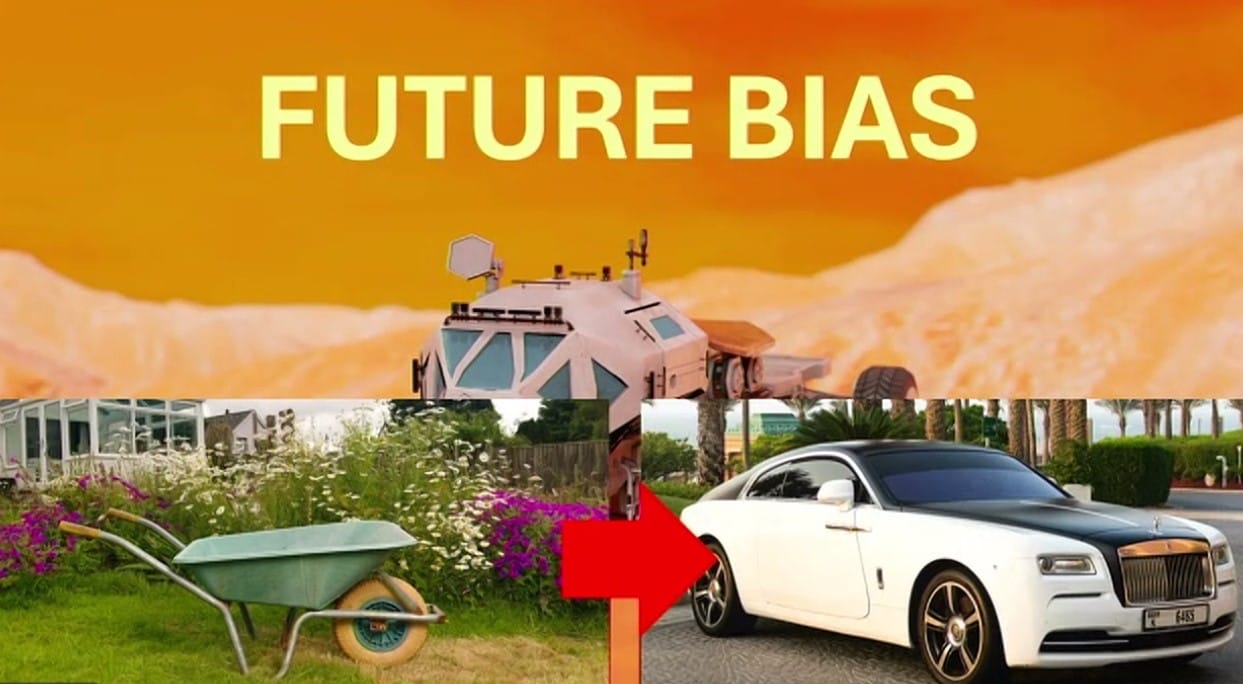
Future bias: our persistent "technophilia" and belief in the myth of progress, even when all the benefits promised by this narrative aren't adding up. With advanced health care, we see higher rates of disease. With social media, we get less society. We embrace innovations without testing them, and embrace technological shortcuts without anticipating the massive consequences they will have in our lives.
And finally, action bias: the human preference for action above inaction.
"Earth does not need to be saved, "George said. And yet: "We're trying to fix ecosystems by managing them. We're creating green products that are anything but green. And we are envisaging green cities, when we should be building no more cities."
Instead of taking action, George argued, what we need is to embrace "thoughtful inaction."
"The benefits of inaction are systemic, long-lasting, sustainable and permanent," he said.
While the idea of no capitalism, no markets, no corporations, no broligarchs may seem revolutionary to some of us, he said, this is actually how the Earth has worked for 3.5 billion years!
The Marigold Flower: a powerful collapse companion!
Thomas Homer-Dixon, the Executive Director of the Cascade Institute in Canada, opened Day 2 of the Forum with an online address highlighting how the complexity and chaos of the polycrisis has the potential to be a source of creative energy and novelty on a rapidly changing planet. Given the magnitude of global heating amidst the breakdown of systems and institutions, he said, many feel that the possibilities for a good life are slipping away.
Yet the breakdown we are seeing in world systems may in fact be a necessary precursor or starting point to new possibilities that cannot be realized within existing structures. Catagenesis (pdf) is the term coined by the Institute to describe a process of breakdown and rebirth that the world is now going through. "So we're all charged with finding a pathway forward, finding positive possibilities in a situation of enormous complexity, uncertainty, and yes, breakdown," he said.
On this thread, imaginative futurist and "collapse companion" Maya Frost had plenty of inspiration to share. As the founder of Collapse Forward and the creator of Doom to Bloom, a process designed to help collapse aware leaders transform their dread into depth, discovery, daring and doing, Maya has worked with hundreds of people across 20 countries who experienced deep anxiety, grief and rupture in their lives and then harnessed their pain and outrage as a catalyst to creative, emancipatory transformation!
As Maya shared, the humble, bright orange marigold flower, a companion plant that protects and supports others by its very presence, became the inspiration for her work. After sharing her own harrowing personal marigold story, Maya went on to share the inspiring stories of several people she worked with. "Grief comes bearing gifts. The unboxing is brutal. And in this time of entangled crises it's critical that we recognize our grief and open the gifts that it offers us," she said.
For example, there was Atsuko, a Japanese woman whose husband, a doctor, was one of the first people in Japan to die of COVID-19. Atsuko never had the chance to say goodbye or hold the culturally important funeral rites for her husband. On top of this, her two beloved pets were euthanized due to the early uncertainties around transmission of the virus, and she was isolated in a quarantine facility for a month. On top of her grief, she was outraged.
In her daily conversations with Maya over that time, her outrage began to transform into creative energy. In the process of rewilding her imagination, she realized the importance of all her friendships. As she and Maya talked about the widespread problem of loneliness in Japan, she realized that she always had a gift of making friends easily. So she created an online course on how to make friends through simple actions in the real world, helping thousands of people grow their social bonds at a time when everyone was lonely and isolated.
"Yes, we need systems and organizations to adapt, but we mustn't underestimate the power of individuals. When anxiety is converted into curiosity and awareness, and grief and outrage become action, we find agency. When we help others, we feel less helpless. And when we connect, when we find our people and our place, we can build what we are longing for together," Maya said.
"That's resilience. That's adaptation. That's resistance," Maya said. "So start seeing anxiety as a habit that can be broken. Outrage as fuel for creative action. Imagination as essential. Curiosity as healing. And joy as what draws us toward what is possible."
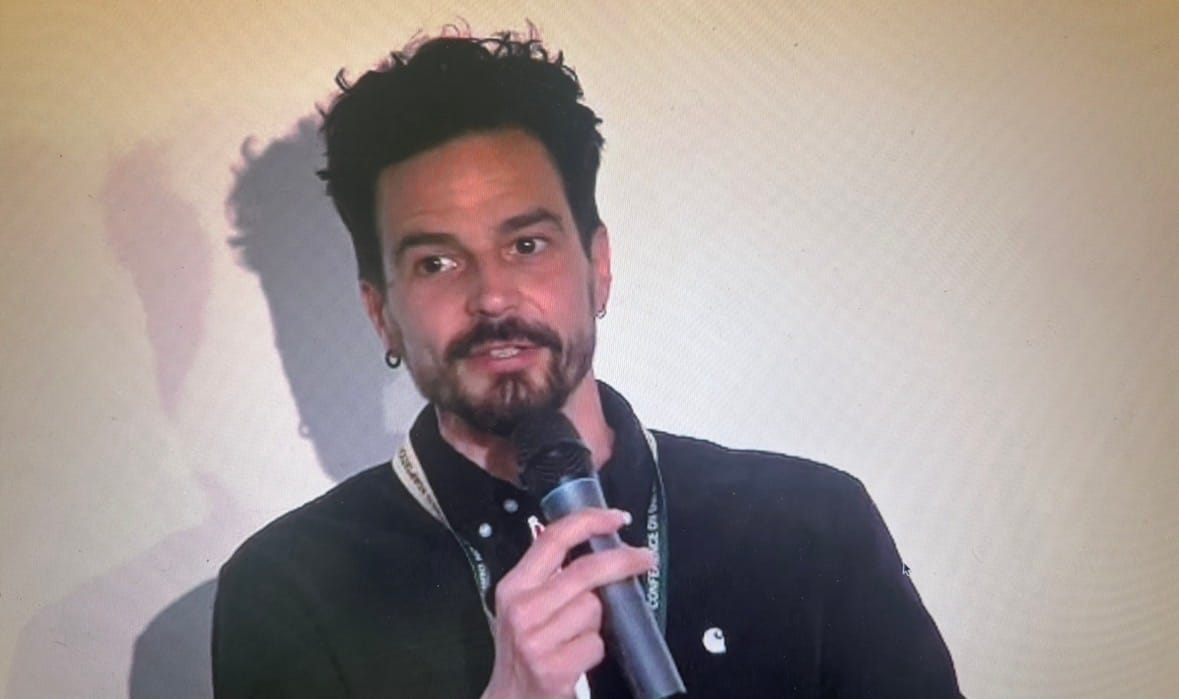
"Which Collapse Will You Choose?"
The final speaker was the eminent collapsology thinker and author Pablo Servigne, a biologist and ethologist whose work, Balázs noted, has profoundly shaped the language of collapse, mutual aid and collective resilience.
"My job in a nutshell is to tell people that we're all going to die, possibly sooner than expected. And always with a smile, because I sincerely believe that facing up to difficult truths together with connection and joy is the only way forward," Pablo said.
To illustrate this, he invoked the meerkat, a small social animal from southern Africa who is all about facing fears – "because fear is at the heart of everything" – and sharing warm social bonds. In times of disruption and collapse, he said, these warm social bonds are the greatest protection we have.
Pablo described his book Le Pouvoir du Suricate ("The Power of the Meerkat" in English, co-authored with martial arts teacher and trauma therapist Nathan Obadaia), which draws on how meerkats respond to signals of danger through the 4F's: fight, flight, freeze or friends and family. "We all have a meerkat inside of us. It's a metaphor for our primitive nervous system," he said.
If our relaxed state of being is green, the state of rest, relaxation and friends; when danger strikes our inner meerkat moves to red: action and movement, problems and solutions. When the danger is overwhelming, our meerkat system moves to blue: freeze, collapse, immobility, numbness and dissociation. "We have to train our meerkats and navigate between green and red, widen our window of freedom," Pablo said.
Social connection is the prerequisite to action, he said. This is beautifully illustrated in the example of Mutual Aid, described by the Russian geographer and anarchist Peter Kropotkin, whose 1906 book challenged the prevailing dogmas of social Darwinism. "He demonstrated that in nature, cooperation is more important than competition, and that throughout evolution, those who have survived are not the strongest, but those who help one another the most," Pablo said. "From bacteria to ants, from trees to humans, mutual aid is everywhere since the beginning of life. It's not only a moral value, it is a principle of life."
"Cooperation is an evolutionary, stable strategy, particularly in difficult conditions. Life teaches us that mutual aid emerges in a hostile environment, because it enables us to survive, and even better, to live," he said. "The secret is to feel that we need each other."
Co-leading a research project with the URD group, a humanitarian think tank, Pablo said he has been exploring the factors that enable mutual aid to emerge. Mutual aid always emerges in a disaster – long before the professional rescue teams arrive, he said.
"People carry the elderly. They provide shelter, they cook meals, they treat injuries, they transport one another, they share water, they organize information, and so on. In short, people remain calm and organize themselves with great collective intelligence," he said.
Who are the people you trust enough to call at 3am when there's a crisis? These are your "rough weather networks," as Joanna Macy said, of close friends, family members, neighbors who you can always count on to help. "These networks are a vital fabric of trust that keep us standing when everything else is shaking. It's not just surviving in a crisis. It gives meaning to everyday life and reduces fear. It increases our capacity to act," Pablo said.
Through disruption and collapse, the bonds of meaning, connection, joy and community often strengthen through mutual aid. "It's what made us human since the dawn of time," Pablo said.
So as some things collapse, others can be liberated. Two collapses are happening at once, and they are mutually intertwined. There is the collapse of Gaia, our planetary home, and there is the collapse of the Mega-Machine, that dominating, extractive, Goliath's Curse structure that wants to control us and keep us obedient and dependent. As the Mega-Machine destroys Gaia, Gaia's collapse undermines the Mega-Machine, Pablo said.
He asked: Could the lessons of collapsology, as a body of knowledge, be used to help prevent the collapse of Gaia, while triggering the collapse of the Mega-Machine? By dismantling the rigid structures to help something more flexible, adaptive, robust and capable of navigating uncertainty to emerge – like a spider's web? Like the metamorphosis of the caterpillar into the butterfly? Or the metamorphosis of human social bonds into vibrant networks of bioregionalism and permaculture?
"We are entering a chaotic period," said Pablo. "There will be dissent, and you know what? That's fine. It's a phase of chaos, it's a phase of creation. When there's a fire in the forest, the forest regrows. It does not regrow in neat, orderly rows. We need creative chaos. We need to breathe. Breathe in, breathe out."
The question is: "Which collapse will you choose?"
We wish to express our appreciation and gratitude to the organizers of the World Adaptation Forum, Zsolt Szalóczy and Balázs Stumpf-Biró, and to all the speakers and moderators for the opportunity to weave stories from this inspiring, stimulating and critically important gathering.
Our StoryMoss vision is to be a heart-centered StoryWeaving, StoryHealing collaborator, engaging with regenerative artists, scientists, healers, practitioners and communities around the world, co-weaving stories from different perspectives and ways of knowing, and infusing them with joy, creativity, beauty, deep ecology, eco-spirituality and Active Hope.
View our StoryWeaving Salon sessions for the World Adaptation Forum on YouTube: