Riane Eisler and John D. Liu in Conversation: Weaving Partnership Systems with the Flourishing Path
Partnership expresses the values of equality, care, mutual aid and non-violence. The Flourishing Path is a movement that embodies Partnership values – it describes the vision of Dr. Jane Goodall for an alternative to humanity's current path of destruction. A path of consciousness and generosity.
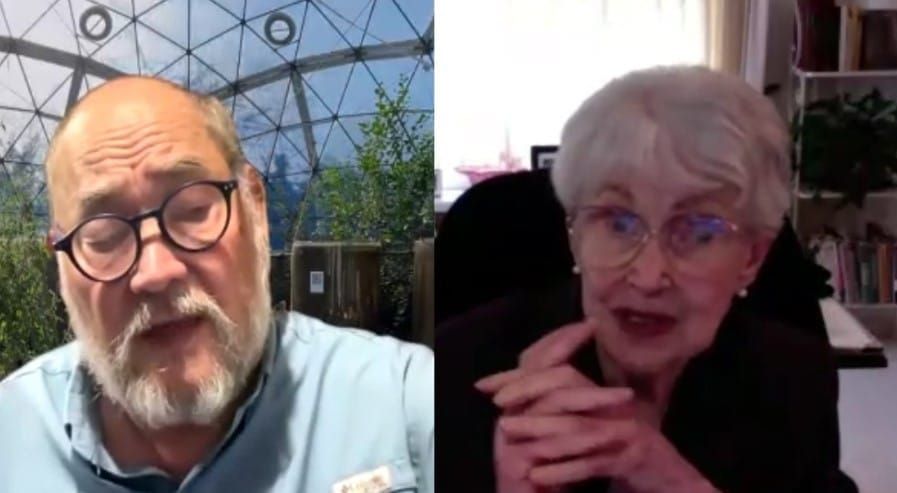
StoryMoss was deeply honored to host two great minds and spirits in conversation – the brilliant cultural historian and systems thinker Dr. Riane Eisler, and the legendary filmmaker and ecosystem restoration champion John D. Liu. This conversation was a powerful weaving of Riane's insights – gleaned from a lifetime spent studying the systems and cultural patterns that shape human behavior across families and societies – with John's vision of nurturing small communities of collaboration, creativity and care to restore the Earth's ecosystems. Together in conversation, Riane and John explored enlivening ideas and practical pathways that all of us can take towards a future of cherishing life and healing our hearts, communities and lands.
We're delighted to share Riane and John's warm, heartfelt and deeply inspiring conversation here!
Riane is renowned for developing the concept of Partnership and Domination systems. Her life's inquiry began in childhood, as she asked herself why human beings so often tend towards violence and domination, despite our strong, innate capacities for empathy, love and care. Fleeing from the Nazis with her parents because of their Jewish heritage, then landing in Cuba and experiencing shocking inequalities before settling in the United States at age 14, Riane grew up asking: "Does it have to be this way?"
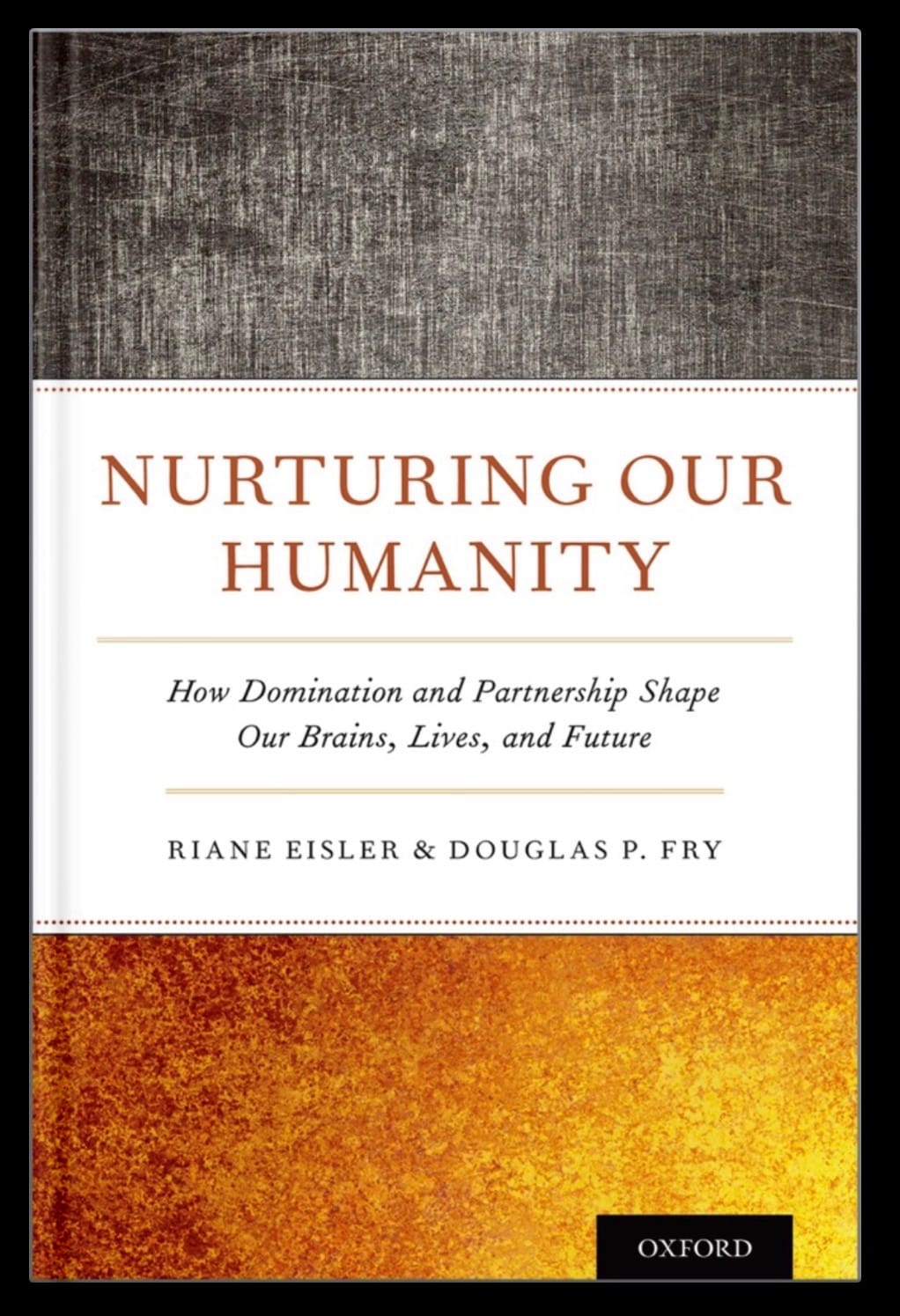
In her long exploration of this question, she developed the Partnership-Domination social scale, a framework she has explored through different lenses in numerous books including The Chalice and the Blade: Our History, Our Future (1987); The Real Wealth of Nations: Creating a Caring Economics (2007); and Nurturing Our Humanity: How Domination and Partnership Shape our Brains, Lives and Future (with Douglas Fry, 2019). The idea of Partnership expresses the values of equality, care, mutual aid and non-violence. As Riane explained, she coined the Partnership and Domination terms, because we have lacked the language to be able to understand these two distinct configurations and how they shape our orientation to the world. From the nuclear family to the nation-state, the patterns of Partnership and Domination are clearly expressed in the four cornerstones she identified: family and childhood, gender, economics and stories and language. All hardline Domination regimes, for example – whether religious or secular, leftist or rightist, capitalist or socialist – show similar kinds of authoritarian, fear-based family structures; rigid gender roles and stereotypes; top-down, exploitative economies that devalue nature and marginalize care work; and oppressive, divisive "us-versus-them" language and narratives that reinforce the dominance hierarchy.
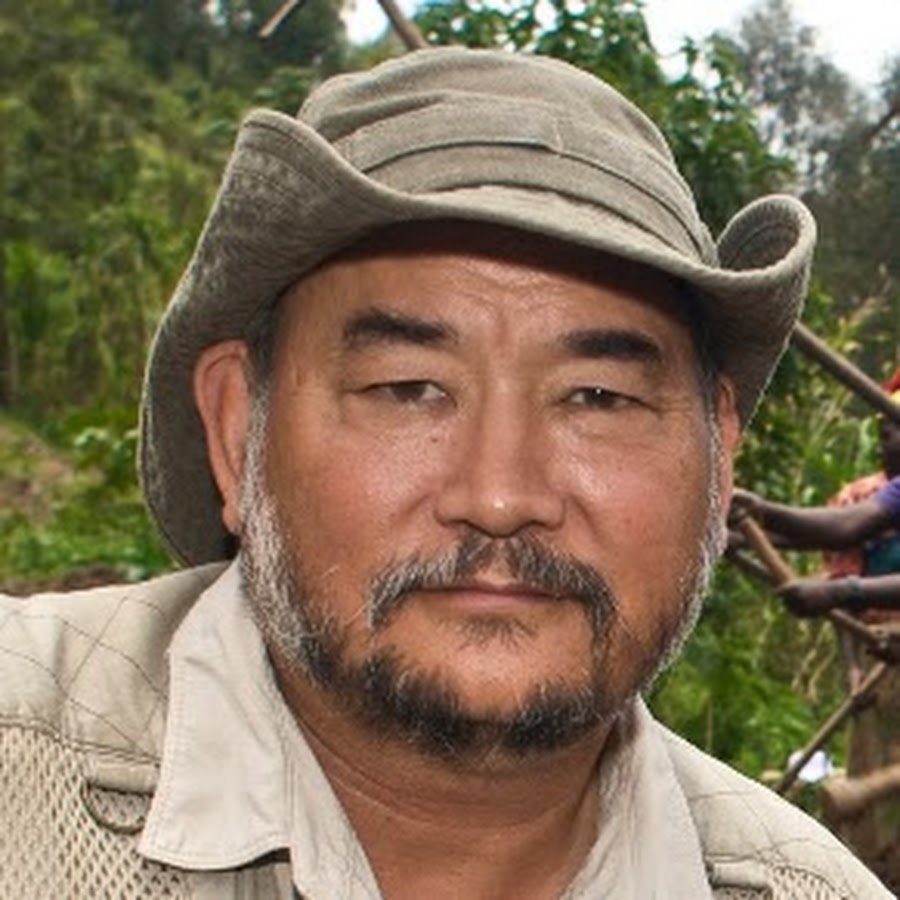
In contrast to Riane, John's early childhood in Bloomington, Indiana was tranquil – too much so for his father's liking. When John was in his early teens, his family set off to travel the world by steam ship. A curious youth, he was already filming on an 8mm camera and stubbornly asking questions about the meaning of life – something none of the adults wanted to talk about! He later traveled to China, his father's homeland, and became a journalist and cameraman, covering major geopolitical events of the late twentieth century.
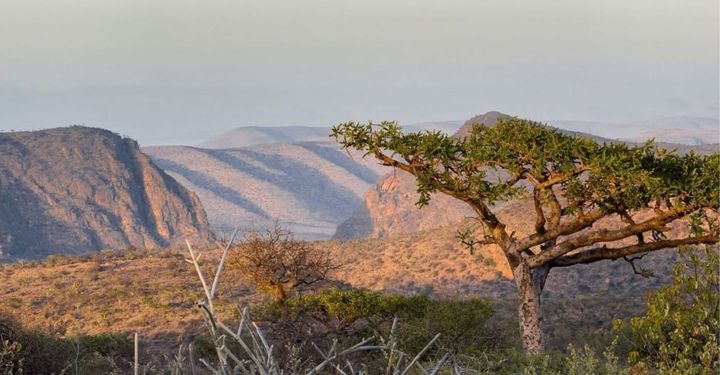
During the making of his landmark film on the large-scale restoration of the Loess Plateau in China (above), John came to understand that this entire landscape had been degraded over centuries of human over-exploitation. He observed a similar pattern across the major "Cradle of Civilization" landscapes around the world, which set him on a new life journey to understand how ecosystems become degraded, and what it takes to restore them back to life. He now works around the world with the Ecosystem Restoration Communities movement and the Commonland Foundation, inspired by his friend the late Dr. Jane Goodall’s vision of a Flourishing Path – of consciousness and generosity.
Both Riane and John had to look to the past and connect the dots in order to see the possibilities of transformation to more flourishing futures. In writing the Chalice and the Blade, Riane delved into the work of archeologist Marija Gimbutas and pieced together a narrative of ancient, matrilineal European cultures flourishing (imperfectly, of course) over many millennia with few signs of systemic violence and warfare. The rise of domination cultures in the last 5,000 to 10,000 years – over the same time period as the ancient landscape degradation John had observed – reshaped our very understanding of what it means to be human. In a Partnership system, the Chalice represents the power to give life, to nurture life, to illuminate life. The Blade of Domination systems, in contrast, represents the power to take life, to instill fear, to dominate and control life. "That's what the struggle for our future is really about," Riane said.
The Flourishing Path is a movement that embodies Partnership values. It was envisioned by John and his friend the late Dr. Jane Goodall to describe an alternative to humanity's current path of destruction. As John remarked: "It's not about income, it's about outcome – if your outcome is care; if your outcome is kindness, gratitude and fulfillment. That's what we're looking at with this concept of community-based enterprises, community-based land trusts. This is what it looks like on the Flourishing Path. We see that there's care for children, there's care for the elderly, there's education, and people are reaching their creative potential by having craft and art and machines, and whatever's necessary, not as individuals but for the whole community. Basically if we share, we all have everything."
Here are a couple of beautiful and memorable passages from the conversation (lightly edited):
28:50 John: "There were certain things that came to me during this path. I mean one was Dr. Jane Goodall. I had this wonderful period where I could work with her until just recently when she passed away. She made me realize several things, that we are connected to all these other living beings, and that they are not nothing. You can't treat them badly and just imagine that we're superior to them. And that there's a lot to learn from them. And when you go into it there is so much to learn from all these systems. And that is something that actually everyone can understand.
It's not something that has to become totally mystery, although there are limits. I think we reach… we reach the ineffable at some point, which is also okay if you think about that, that we may not know everything. That's what it says in Vedic scriptures, and that's also what it says in the Bible. So, maybe we're seeking the peace that passes understanding, and that, that wouldn't be wrong. And also, I think that the other thing that we're often worried about, with this domination thing, too, potentially, is that we want to act as if we can control everything, but obviously we can't. And so, we're not accepting what's true. We're grasping for something which is fundamentally untrue.
And I guess this brings me around to the concept of the flourishing path, because there is a way to be kind. There is a way to be happier, and to do things not simply for yourself, but also for others. And at some point, there's a joining of all of these things where we could learn to share, we could learn to live together. And I think that's kind of been the direction. So if you look at the majority of people, they're not trying to kill each other, they're quite wonderful. And so tiny minorities are the dominant factors, and they're learning how to dominate, and they're learning how to control. And the rest of the people are just trying to survive and get along.
But now, if you don't just try to survive and get along, but you want to have a really good time, then this is, I think, where the arc of consciousness is really striving or hoping for, is imagining that we can live together in peace. If we all share, we all have everything, you know, clearly, we can manufacture any amount of anything, but why do we do that? It's mostly just junk, what's gonna end up in the trash pile. So we really don't want that. We want to make sure that we have the biological and physical evolutionary outcomes that made Paradise on Earth. And why don't we? What could be better than that? You know, it can't be better than that."
41:44: Riane: "So this is not a question of women against men or men against women. It is the question for our future. How can we really move to an economics? A caring economics of partnerism that values caring for people, starting at birth, and caring for our natural environment, our Mother Earth, and all the species that live in it, including ourselves, which we somehow have forgotten. We're supposed to conquer nature, right?
But look, the thing about it is we can do it. There are trends in this direction. As I said, you know, all of these mass movements have challenged Domination. But we have to connect the dots. And stop marginalizing two of the cornerstones: family and childhood, because of what neuroscience tells us. And gender, how gender is defined is not, quote, a women's issue. It is a central principle, a social principle for organizing families, education, economics."
For Further reading and viewing:
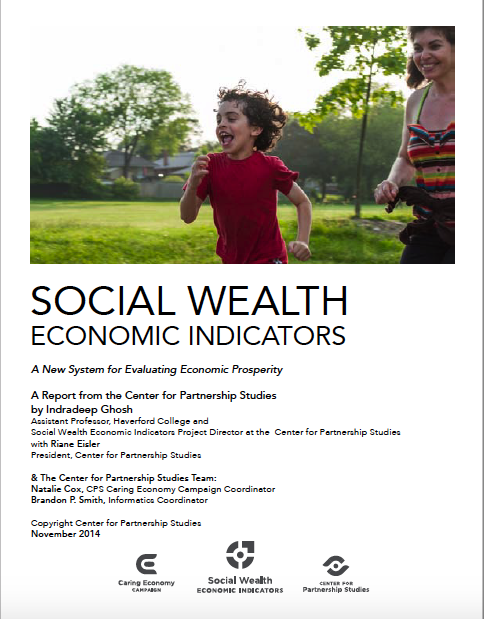
Riane spoke about Social Wealth Economic Indicators developed by the Center for Partnership Systems:

She also spoke about the Peace Begins at Home Summit, which gathered more than 2,000 participants from around the world in 2025 to explore how shifting toward Partnership systems in families can help lay the foundations for a more peaceful world. Find out more about the Summit and watch Riane's keynote address:

John spoke about the Friends of the Ecosystem Restoration Movement for more information and support:


Watch more of John's videos on his YouTube Channel:

StoryMoss would like to express our gratitude to Eli Ingraham, research fellow at r3.0 and former director of the Center for Partnership Systems, who made this interview possible. Riane also spoke with Bill Baue of r3.0 in this public conversation on Partnership and Bioregionalism:
Our StoryMoss vision is to be a heart-centered StoryWeaving, StoryHealing collaborator, weaving with deep ecology thinkers and practitioners around the world to explore and amplify the collective field of regenerative storytelling in a light, joyful and evocative way, inspired by a vision of Active Hope. Please hit the subscribe button to support and follow our work, and find us on YouTube, Substack, LinkedIn and Instagram.