Life without deadlines, without goals, without owners by Salvador Perez
La Vida sin plazos, sin metas, sin dueño por Salvador Perez - 2nd part Spanish Translation
Listening to Lyla June always teaches me things. Things that I had often intuited or reflected on personally, but there is always a perspective, a phrase, a story that moves me. On this occasion, in the conversation entitled “Indigenous Systems of Physical and Emotional Abundance – Practicing Attunement to Heal our Climate” hosted by Sonita Mbah as part of The Pocket Project's Climate Consciousness Summit 2025, it could not be any different.
Especially because the conversation was rooted in food systems that emerge from ancestral indigenous practices, not as technical solutions, but as expressions of an embodied relationality with the soil and the cycle of life. This is a topic that resonates deeply with me because of my personal connection to the soil in the peri-urban world.
I say “to the soil” and not “to food” because I understand food as the result of the reciprocal relationship that arises when we take care of the soil and it takes care of us.
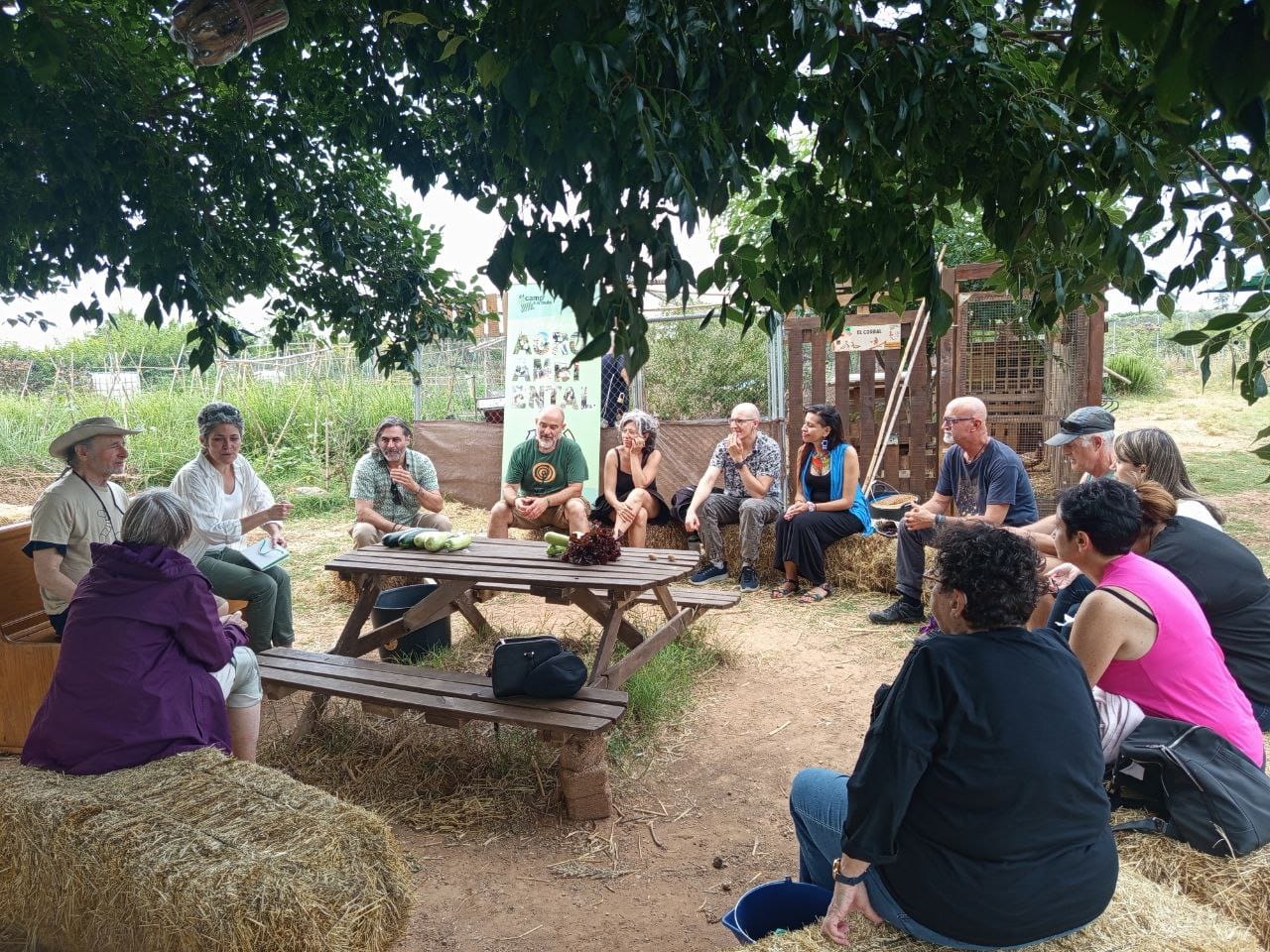
Throughout the conversation, I connected with the ceremonial dimension of our relationship with life and the need to recognize the sacredness of life once again.
This was something that Sonita highlighted at the beginning of the conversation, and it resonated deeply with me. It reminded me of the importance of that connection—and how, as an European, white, heterosexual man, I had unconsciously distanced myself from it—as well as the urgency to reclaim it.
Hearing how, for thousands of years, ecosystems such as the oyster beds of the Chesapeake Bay or the clam gardens in Hawaii—with more than 3,000 years of history—were not harvested, but rather were a form of sacred conversation with the sea. Living ecosystems that indigenous wisdom centered on respect has maintained for thousands of years and that, today, have been devastated by colonial and capitalist extractivism. The extractivism of meaning, not just of goods.
The meaning of these realities in their ancestral form—and which can surely be extrapolated to many more degraded ecosystems today and even to others that are in the process of becoming so—speaks to us of time as something non-linear. It allows us to see that mere life regenerates existence. Calm, patience, and listening as rhythms of coexistence. When I speak in this area, I don't like to use the terms short or long term. Here, deadlines don't exist; life exists.
However, when the colonialism I mentioned earlier takes center stage in the narrative, we clearly have to talk about the short term and the long term. As Lyla June rightly says, this capitalist model prioritizes the short term, profit now over the long-term survival of ecosystems. With all that this implies, because they are not even seen as ecosystems. They are understood as sources of supply, without even considering whether they are exhaustible or not.
I observe that this indigenous perspective, which tends to act with the next seven generations in mind, transcends the idea of renewability that modernity has implanted in us. It does so out of a need for the survival of the paradigm it proposes, taking us as far away as possible from the idea of respect and reciprocity. What would it be like to live knowing that our actions today are already sowing the world of those who are not yet born?
In this other framework—far from the colonial perspective—resources are not renewed because they are not resources. Life is not a resource.
Lyla June reinforces, with her gaze, this scandalous truth: a food system focused on economic profits—rather than on general well-being—is a form of violence. In response to this, she proposes systems that provide nutritious and healthy food for the entire population, sourced locally. Systems that improve personal and environmental health, promote equality, respect, and access to real abundance.
From there, I imagine a scenario: we see the collapse approaching. Current food distribution models will not be able to be maintained due to a lack of energy. A food shortage in supermarkets and stores is looming—I am speaking here from an extractivist perspective. And then we realize that the only solution lies in local production, self-sufficiency, community farming, and mutual support.
How would you react?
I imagine another scenario: all this happens abruptly, without warning. We are caught off guard. How would you react?
With the land, with relationships, with land use, with a short-term or long-term view... the answer we give today determines the world we will inhabit tomorrow.
En Español para ustedes:
Escuchar a Lyla June siempre me enseña cosas. Cosas que muchas veces intuía o había reflexionado personalmente, pero siempre hay una mirada, una frase, una historia que me conmueve. En esta ocasión, en la entrevista con el título “Indigenous Systems of Physical and Emotional Abundance – Practising Attunement to Heal our Climate” que Sonita Mbahle hace en el marco de la Climate Consciousness Summit de Pocket Project, no podía ser diferente.
Sobre todo porque la conversación se enraizó en los sistemas alimentarios que emergen de prácticas indígenas ancestrales, no como soluciones técnicas, sino como expresiones de una relacionalidad encarnada con el suelo y el ciclo de la vida. Un tema que me atraviesa completamente por mi conexión personal con el suelo desde el mundo periurbano. Digo con el suelo y no con la alimentación porque entiendo esta como resultado de la relación de reciprocidad que surge cuando nosotras cuidamos de él y él cuida de nosotras.
A lo largo de la entrevista, conecté con la dimensión ceremonial de nuestra relación con la vida y con la necesidad de volver a reconocer lo sagrado en ella. Algo sobre lo que Sonita Mbah puso el foco al inicio, y que me resonó profundamente. Me recordó la importancia de esa conexión —y de cómo, como hombre europeo, blanco y hetero, me fui alejando de ella de modo inconsciente—, así como la urgencia de recuperarla.
Escuchar cómo durante miles de años ecosistemas como los bancos de ostras de la bahía de Chesapeake o los clam gardens —jardines de almejas con más de 3,000 años de historia—, donde la cosecha no era extracción, sino una forma de conversación sagrada con el mar. Ecosistemas vivos que la sabiduría indígena centrada en el respeto ha mantenido durante miles de años y que, en la actualidad, han sido devastados por el extractivismo colonial y capitalista. El extractivismo del significado, no solo del bien.
El significado de estas realidades en su forma ancestral —y que a buen seguro es extrapolable a muchos más ecosistemas degradados hoy e incluso a otros que se encuentran en fase de llegar a estarlo— nos habla del tiempo como algo no lineal. Nos permite ver que la mera vida regenera la existencia. La calma, la paciencia, y la escucha como ritmos de convivencia. Cuando hablo en este ámbito, no me gusta utilizar los términos corto o largo plazo. Aquí los plazos no existen; existe la vida.
Sin embargo, cuando ese colonialismo al que aludía anteriormente toma el protagonismo en el relato, claro que hemos de hablar de corto plazo y de largo plazo. Como bien dice Lyla June, ese modelo capitalista prioriza el corto plazo, el beneficio ahora sobre la supervivencia de los ecosistemas a largo plazo. Con lo que esto significa, porque ni siquiera se ven como ecosistemas. Se entienden como fuentes de aprovisionamiento, sin llegar a plantearse si son agotables o no.
Observo que esta mirada indígena, que suele actuar pensando en las próximas siete generaciones, trasciende esa idea de lo renovable que la modernidad nos ha implantado. Lo hace por necesidad de supervivencia del paradigma que propone, llevándonos lo más lejos posible de la idea del respeto y la reciprocidad. Cómo sería vivir sabiendo que nuestros gestos de hoy ya están sembrando el mundo de quienes aún no han nacido?
En este otro marco —lejos de la mirada colonial—, los recursos no se renuevan, porque no son recursos. La vida no es un recurso.
Lyla June refuerza, con su mirada, esa verdad escandalosa: un sistema alimentario centrado en los beneficios económicos —y no en el bienestar general— es una forma de violencia. Frente a esto, ella propone sistemas que provean alimentos nutritivos y saludables para toda la población, desde la cercanía. Sistemas que mejoren la salud personal y ambiental, que promuevan la igualdad, el respeto y el acceso a la abundancia real.
Desde ahí, me imagino un escenario: vemos el colapso que se acerca. Los modelos actuales de distribución de alimentos no podrán mantenerse por falta de energía. Se avecina —hablo aquí desde el marco extractivista— una falta de alimentos en supermercados y tiendas. Y entonces, nos damos cuenta de que la única solución está en la producción local, el autoabastecimiento, el cultivo comunitario, el apoyo mutuo.
¿Cómo reaccionarías?
Me imagino otro escenario: todo esto ocurre de modo abrupto, sin previsión. Lo encontramos de golpe.
¿Cómo reaccionarías?
Con la tierra, con las relaciones, con el uso del suelo, con la mirada puesta en el corto plazo o en el largo… la respuesta que demos hoy determina el mundo que habitaremos mañana.