An Ancient Futures Journey in the Himalayas with Pramod Parajuli
Traditional Himalayan life was based on understanding the water cycle, the sacred union between Indra and Lakshmi. In the face of dramatic disruption, renewed ecological wisdom must shape a restorative, regenerative vision for Nepal and this wider region known as the world's Third Pole
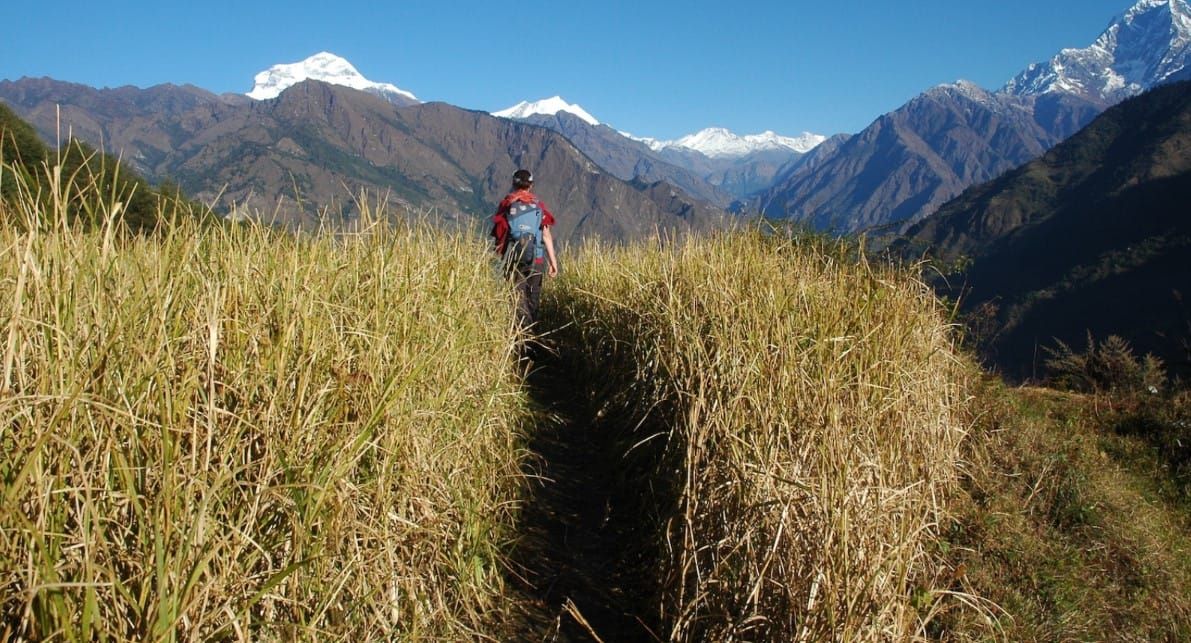
We met Prof. Pramod Parajuli in one of the monthly r3.0 Confluencing calls earlier this year, and were fascinated by his brief description of his work to revive indigenous traditions of knowledge and inspire youth-led agro-ecological economies and learning ecosystems in the Himalayan foothills of Nepal, his birthplace. Pramod is founder and thought leader of Annapurna Pluriversities: Learning to Regenerate While Regenerating to Learn. He also hosts the online forum Regenerative Nepal: Dream to Design.
Today we release the first in a new dialogue series with Pramod, exploring his fascinating 7-decade life journey – from his traditional village upbringing to his academic career in the United States (entering Stanford University in 1983) – and his vision for a vibrant Himalayan future rooted in indigenous cosmologies and regenerative learning ecosystems. In this, our first conversation recorded in early 2026 before he travelled to Nepal from March to May, we listened to parts of Pramod's life story and reflections, as he set the personal, historical, geographical and cultural context for our wider inquiry together. We just recorded Part 2 with Pramod and will share this in the next few weeks!
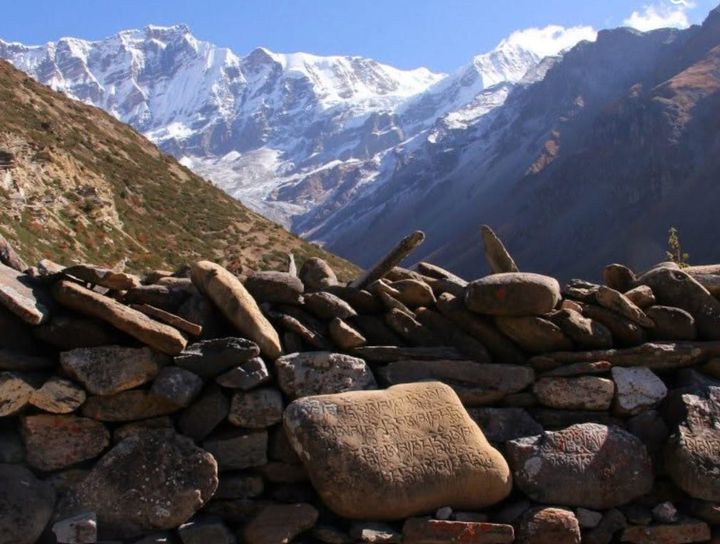
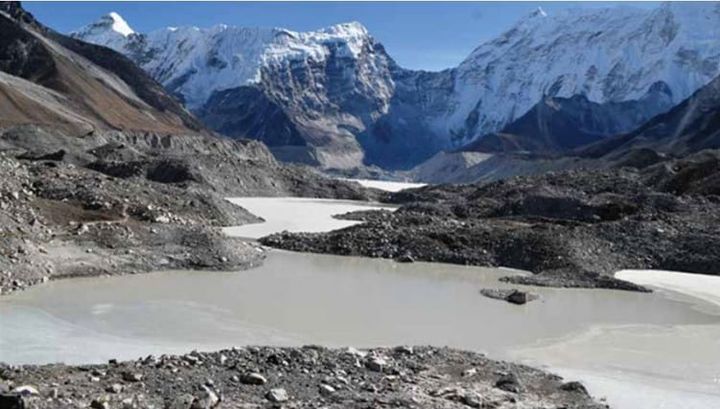
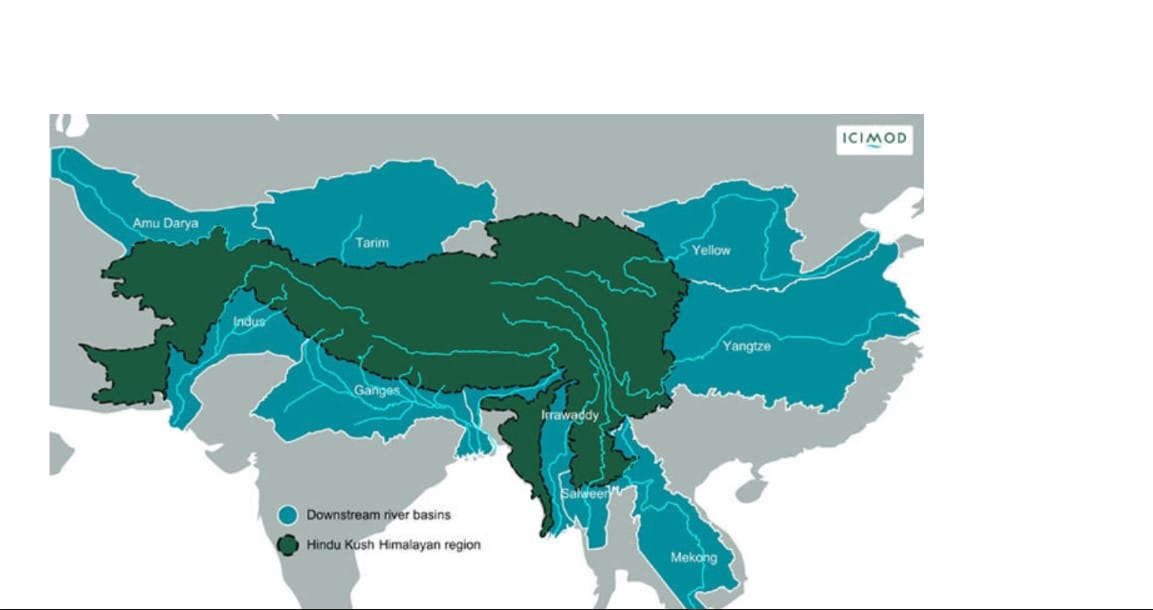
Pramod oriented us to the planetary significance of the Himalayas, the majestic mountain range that forms part of the Hindu Kush-Karakoram Himalayan system (HKKH), known as the Third Pole because of the massive glaciers, snowfields, ice and water that supports a human population of billions! He described his childhood during the 1950s and 60s as a time of profound opening but also disconnect, as the old indigenous cosmologies and systems of time, astrology, learning, ecology, economy and water were uprooted by the linear, industrial logics of British rule and the European hegemonic apparatuses such as schools, hospitals, laboratories and large dams that followed.
Listen to the podcast here, watch on YouTube in two parts, or read the highlights below:
And Part 2:
While completing post-graduate studies in law and education in Kathmandu in 1975, Pramod got hold of two books that set the course for his life's journey: Pedagogy of the Oppressed by Paolo Friere and Deschooling Society by Ivan Illich. "The rest of my life has been almost like the 3 of us – the Freirean stream, the Illichian stream - which also brings the Mahatma Gandhian and the ecological and the vernacular - and myself. I am one of those people who can swim between different streams and not be swallowed by any of them, but able to bring the insight from each, and then create something unique," he said. (As we will be exploring with Pramod in this conversation series!)
From Learning Gardens to Annapurna Pluriversities
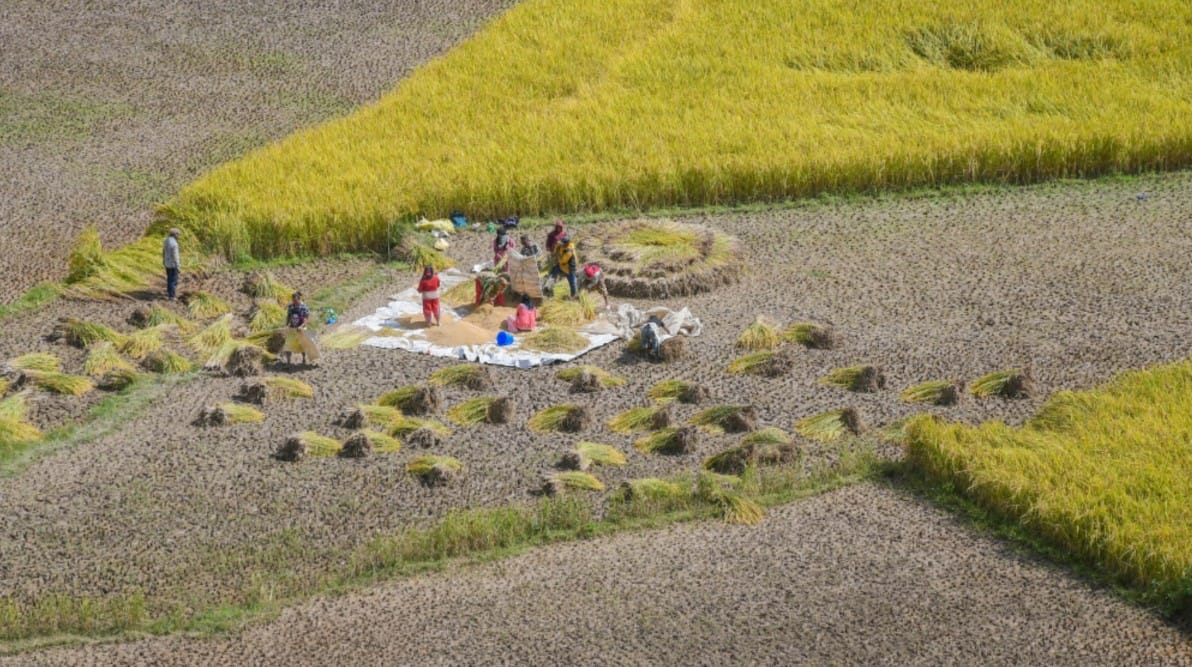
These three streams came together in The Learning Gardens project, which Pramod helped to lead and implement as a professor in the Graduate School of Education/Leadership for Sustainability Education at Portland State University in Oregon, USA (2001-2008). The Learning Gardens initiative brought together a team of faculty members, master's students and teachers from the Portland schools and engaged grade 4-8 learners in designing permaculture, edible and pollinator gardens. A unique learning ecosystem was designed in which youngsters were “learning to garden while they were also gardening to learn.” The team was able to integrate the benchmarks of the formal school curriculum, such as learning about nutrition, photosynthesis, soil and soil-carbon, pollination, marketing and so forth, into the daily hands-on practices of tending the garden. To the team's delight, they were able to fully sync learning in every subject, grade by grade, topic by topic, with the activities in the garden, day-by-day, week-by-week, month-by-month.
"That was in my view one of the fullest expressions of my life journey, from a peasant background very rooted in the everyday rhythms of the weather, the climate, the role of the snakes, the earthworms, the water bodies, the birds, the pollinators. The way we had a whole universe that was alive and each of the elements of that system knew what it was doing and how it was connected with the rest," he reflected.
Rooted in the old ways, his life's journey was at the same time shaped by the notion of the path to modernity, more accurately captured as Development (Bikas in Nepali). When he was five, ready-made clothing from India began to appear in the village, steadily replacing the hand-woven Gharbunas (home-grown and spun) kurtas, shawls and dresses people had always made from locally produced cotton. Sugar, salt, sweets and biscuits all made their appearance in the village around the same time. The next year came the new British school, constructed by all the villagers as a special budget provided for western-educated teachers (the teachers were mostly retired soldiers of the British and Indian armies) to promote reading, writing and arithmetic. This fancy new school on the top of the hill replaced the vernacular school established by Pramod's father (the late Pundit and Astrologer Kedar Nath Parajuli), where children had previously learned about the stars, astrology and traditional texts. The new school also introduced the western clock, hanging at the center of the second floor of the building, and its linear construct of time.
The clock displaced Pramod himself as the local timekeeper! "This is so intimately related to my journey as an academic, as a researcher, grassroots activist, whatever you call it," he reflected. "Before that clock arrived in my village I was the timekeeper. My father had taught me to time the morning at school, the mid day break and the afternoon closing of the school by watching my own shadow. Imagine that, because you know how the sun does different things in different months, different parts of the month, the full moon, the half moon, the dark moon."
The village didn't need two schools, so his father's vernacular school (called Bhaskar Primary School) moved to another village three miles away. The English school remained. "Even the idea of time, this question is still in me so deeply," Pramod reflected. "This clock displaced me, and that is how the questioning of modernity, the whole idea of development, Nepal becoming like Kansas, imaged after the lower middle class America – it was all inbuilt in my own life journey, where all the disconnects began in the learning ecosystem, the thinking and relational ecosystems, the clothing ecosystem, the food ecosystem."
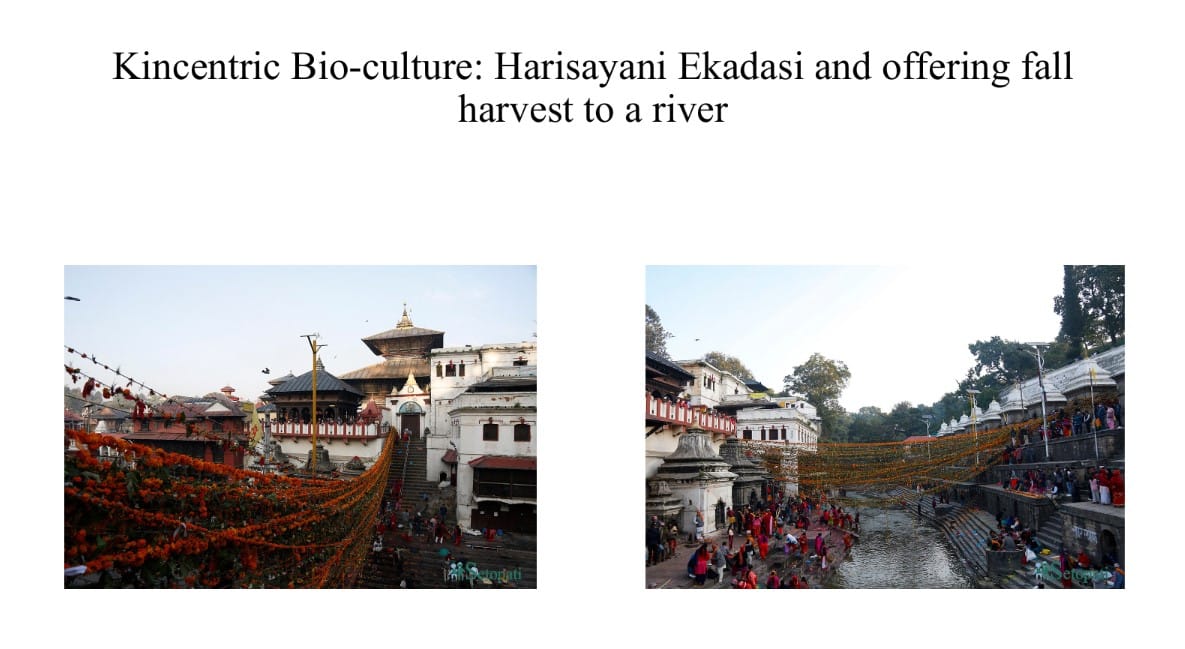
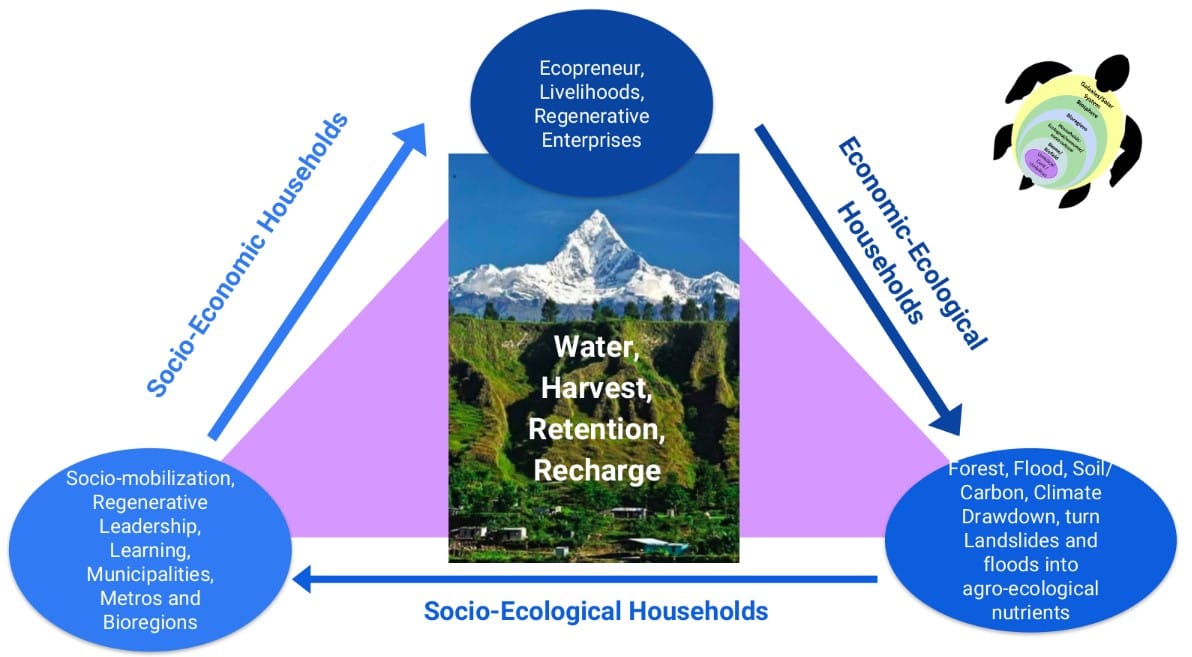
As Pramod described, the old vernacular ways can still help shape and offer foundations towards the mapping, dreaming and designing of a restorative, regenerative vision for Nepal and the wider Himalayan landscapes. We will explore this in our upcoming sessions, starting with the water cycle. In the current decade, the monsoons have become erratic and climatic disruptions are regular, making it essential to work on regenerating the systems of harvesting and retaining water, as well as recharging the natural mountain water springs.
Harvesting the Ancient Futures
In the Himalayan-wide mythology (embracing the trio of Tantra, Mantra and Yantra, to be elaborated during future sessions), Indra is the god of rain, thunder as well as hailstorms. Lakshmi is the goddess of the soil carbon – the fluffy six inches of topsoil. When there is love between Indra and Lakshmi, the fluffy topsoil receives the rain. But now as the Himalayan landscapes are dehydrated and drying, and the soil is losing its fertility; the soil-carbon which absorbs and retains the rain and moisture is also depleting. With the introduction of chemical fertilizers and pesticides, the regenerative principle has been lost, the life cycles have been broken. The roots of the problem lies with the thinking within Nepal's agricultural colleges, where students are trained in a model of industrialized, chemical-heavy agriculture. "We have hundreds of thousands of agricultural graduates, but they are not building the soil," said Pramod, who knows of only a handful of graduates who are engaged in regenerative work.
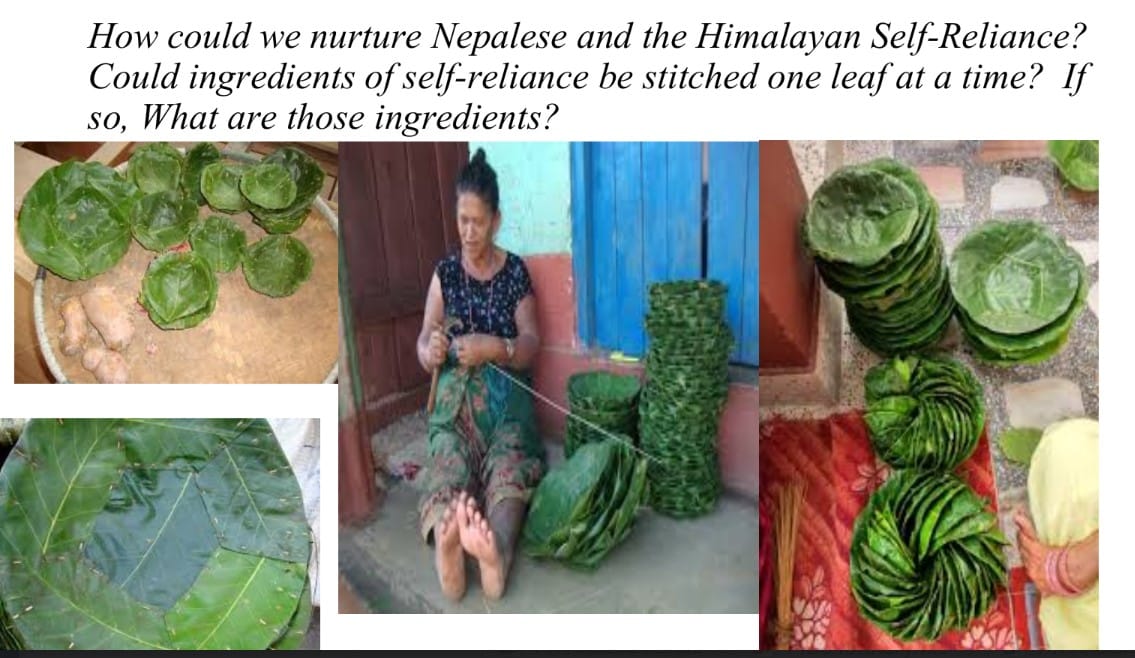
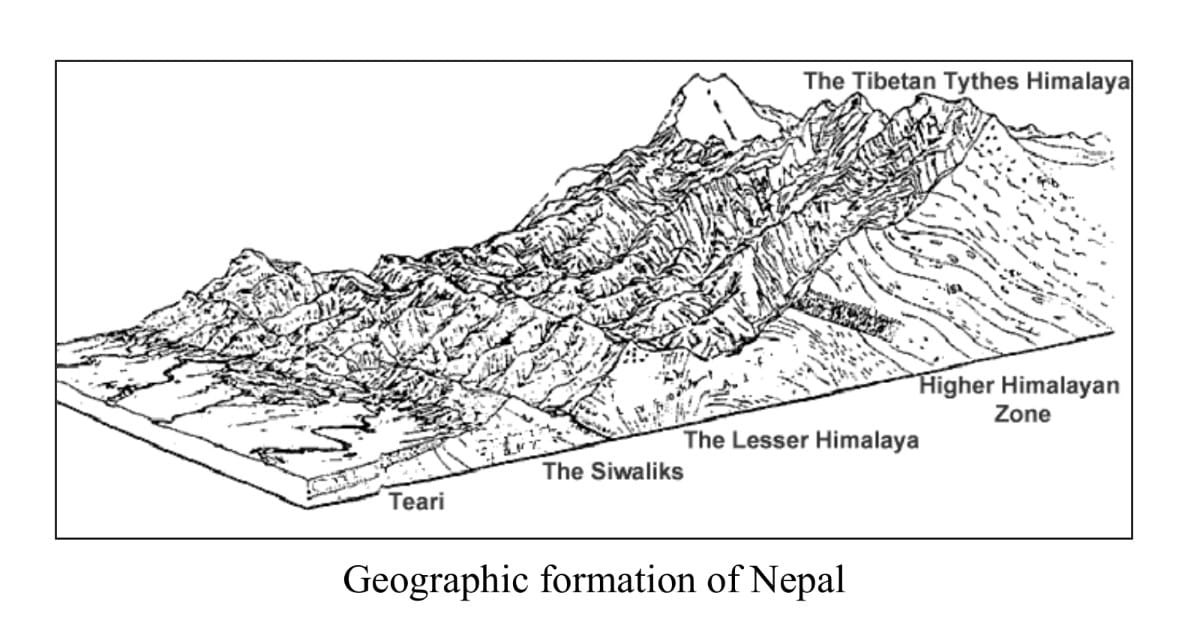
When we spoke, Pramod was engaging online with an enthusiastic group of some 310 people in Nepal, India, China and globally, called Regenerative Nepal: Dream and Design, to shape a vision of Annapurna Pluriversities: Learning to Regenerate while Regenerating to Learn. This forum includes leaders of some 25 municipalities, as well as representatives from 75 diverse initiatives, and collectives. Fellow participants and contributors are teachers, food growers, health caregivers, politicians, research scholars and so forth. Building on what participants are already engaged in, the group is collectively moving towards regenerative economies and learning ecosystems across the five distinct ecological zones of the Himalayas, from the high desert Tibetan plateau and the remote the Mustang region in the rain shadow, to the lush rice paddies in the foothills.
As Pramod explained: "What I am reminding them – most of them know it anyway, but are told to forget it – because this Indra-Lakshmi cycle is what keeps the whole web of life going. The web of life that Fritjof Capra talks about, that the team under the umbrellas of Biomimicry and Bioneers talks about. We in Nepal and Himalayas had that figured out and had a way of absorbing the rainfall into the soil and percolating down to the deeper grounds. Harvesting, retaining was so effective during my childhood that by August, the end of Monsoon period, we would have 5 or 6 springs bubbling up. So we knew how to harvest water, how to retain water, so by harvesting and retaining water we would be recharging water. So the disconnect has happened at all three levels, do you see?"
Bamboo is another essential ingredient in the vision of a restorative, regenerative
Nepalese/Himalayan economy. It grows with natural abundance in the Himalayas, provides natural flood and landslide control, and is incredibly versatile. It can be used to make anything from furniture to building materials for homes to schools to temples and Gumbas to clothing. Bamboo and Bamboo forests will be integrated into local agro-forestry and edible-forestry practices which are also intended to address recurrent issues of landslides and floods. How to harvest floods as ingredients for regeneration is one of the design pathways.
Our conversation continued with Pramod's deeper reflections on his family, and how the history of British rule laid foundations for the current politics and economics, bringing the small, isolated Himalayan nation into the global matrix of power and uneven economic exchanges. Sandwiched between the superpowers of India and China, Nepal attracted intense American attention since the 1950s around the all-encompassing idea of “Bikas” (development).
Some of the lightly edited highlights from our conversation:
"Due to their heavy and deep presence in Nepal and harvesting the British Empire's experience of using Nepalese in their army and English language, we became one of the most Americanized societies in the world. Interesting. So there are a lot of hegemonic elements in why would people so deeply embedded in the circle of fertility and the web of life, knowing the role of the water and the snakes serpents (known as Nagas, the regulators of underground waterways) and the pollinators and Indra and Lakshmi and what is fertility are running away from that cosmic entanglements. Some of us are already talking about Peasant (Kisan) Dharma, that we had a way of understanding, doing these things, in certain ways and avoiding certain ways of doing things. You see they were all inbuilt into our sequence and web of life: what and how to grow and eat, how you defecate, how do you pee, how do you carry your child when you are pregnant, and on and on in this fascinating culture," Pramod said.
"Then we got affected by two hegemons: one, the American, European episteme, the Enlightenment, the separation, the disconnect that we know. The other our internal Hindu system of hierarchy and exclusion. After the Vedas and the Bhagavad Gita were describing exactly this cosmic connection, but then the texts later on were influenced by the hegemonic ruling class of India and Nepal. The rulers wanted a subordinate, hierarchical society and the texts and stories were created to support that. That's where the caste code is imposed formally, that you would be legally sanctioned. Civil Codes ensured that people could be killed or put in prison for violating. These two hegemonies are now completely causing the collapse of what I call the socioecological regenerative principles and pathways."
"Now the climate and the coronavirus are bringing us to another phase of human evolution. So all of my work now is based on what happened in November 2019 in terms of the COVID pandemic but that was already coupled by the climatic disruptions. So I have created a diagnostic framework: the Combined Climate Coronavirus Disruptions (CCCDs). Nepal is one of the areas that is absolutely affected, probably in the top five. Nepal would be one of the five most critical areas of this disruption, because of the hegemonic principles working in Nepal for the last 258 years. Interestingly, Nepal as a nation-state came to existence in 1768 AD, 8 years ahead of USA in 1776. Our imposed or somewhat enthusiastic participation in the path of modernity made us very vulnerable because we gave up our way of understanding the soil fertility, the water ways and the ethos of self-reliance. For example, the carbon and soil-carbon are new words but we knew the dharma of keeping the soil as fertile as the body of Lakshmi."
"Now because of the diverse doorways of disruption, the majority of youth have left the country. Another big layer of the situation is even if we say let's rehydrate the landscape there are hardly any people left in the hill and mountain villages to create the water harvesting, water retaining, water recharge systems. Now we need to bring the people back to the hills and that is one of the strategies we are initiating now. You see, a massive shift from the hills to the lowlands and urban areas happened because the lowlands got free of malaria during the early 1960s. Previous to Malaria eradication you would not be able to survive there. Malaria was eradicated in Chitwan and Dang Valleys and rest of lowlands with American assistance for resettlement. It is a fascinating story, in itself."
Searching for Epics of the Emergent Regenerative Epoch
"So I have begun to formulate several principles and historical articulations that could inform dreams and designs into the future. For example, replacing “Enlightenment” now might we need to create a new worldview that is based on deep and delicious “entanglements”? A healthier reciprocal regenerative entanglement is what made us survive in the slopes of the Himalayas. We lost that connection. Now the Enlightenment ethos, the masculinities, the separation, the machine ethos might lead us to more crises, it's already leading us to more crises. We need to escape the hegemony of the west, the machine, what is known as edifice of the techno-industrial-war-complex. The most critical part very few people understand is the Nepali caste system and the formal religious system is not what will deliver us this regenerative new world. We need to articulate completely another form based on the basic principles as laid out in the Vedas and the Bhagavad Geeta."
"I am on the frontline of really deeply digging into what happened over the last 250 to 500 years and looking at that geologically, biologically, ecologically – the food, water, fiber, plastic, cement, the chemical fertilizer, and the oversupply of pesticides and herbicides. This moment (2026 and beyond) seems ripe for what Indy Zohar calls the “Civilizational Optioneering" for the world that could still be liveable, but not possible by current apparatus of power, technology, culture and uneven economic exchange."
"We need a new basis of the vitals of life, from the fractal to the power of the hummingbird. The power of the dragonfly (known as Gainekira in Nepali) and the fireflies (known as Junkiris in Nepali). I was always fascinated by how they could bring so much energy and flow. So we are at the verge and the opening of an amazing new epoch. Amazing new epics are yet to be dreamt, designed and written."
"This interview as the first session and lively conversations we have planned into the future between the three of us is hopefully part of that epoch-building and epochal epic-writing. For that we need a new ground, a new worldview. We need new values as the foundations."
Ultimately, What do we value as worth having and pursuing?
For further viewing: